Norfolk Master Composters

The next Norfolk Master Composters training course will be held on Thursday 18th and Friday 19th April 2013 at Gressenhall Farm and Workhouse near Dereham. If you are interested in attending and becoming a Master Composter please contact the organisers on  0344 800 8020, email: mastercomposters@norfolk.gov.uk.

Who are Master Composters?

Master Composters are volunteers who encourage people in their local community to start composting at home.

What do Master Composters do?

Master Composters promote composting in a variety of ways that are tailoredto their skills, strengths and interests. This could involve offering support andadvice to friends and neighbours, attending events, giving presentations to interested groups or writing articles for local newsletters. Master Composters are encouraged to think of novel ways to raise awareness of the benefits of home composting.

How can I become a Master Composter?

Anyone over the age of 18 can become a Master Composter. You don’t need to be a composter already or have any volunteer or community group experience. As a volunteer you will receive free training from Garden Organic in home composting and related environmental issues. Once you have completed your training you will be expected to spend 30 hours over the following year promoting home composting as a volunteer. Becoming a Master Composter is a great way to meet new people, learn new skills and benefit from being part of a team that makes a difference.

Horsemeat and the food supply system

The recent horsemeat scandal has encouraged us all to think more deeply about the origins of the food we buy. Of particular relevance is the complexity of the food supply chain. The food supply chain refers to the various stages that food crops and food products pass through on their way from the land to the consumer. If I buy eggs from someone in my village who keeps chickens, the food chain is simple and transparent. But if I buy a ready meal from a supermarket then the food chain is very complex and difficult to unravel. According to NFU President, Peter Kendall, “the longer a supply chain and the more borders it crosses, the less traceable our food is and the more the chain is open to negligence at best, fraud and criminal activity at worst.”

At the height of the scandal, burger chain McDonald’s were confident that its burgers were free of horsemeat because they had invested in supply chains that are relatively simple and transparent and rely on close contact with the British and Irish farmers who produce all of its beef. Only 10% of its chickens come from the UK and Ireland, but it claims to use free-range British eggs, British pork and milk, and burgers made with 100% British and Irish beef.

By contrast, many supermarkets rely on factories producing tens of thousands of tonnes of ready meals. And these factories buy their meat from contractors who buy from traders who may have subcontracted their order to another trader, making the chain of supply very hard to follow. Since the horsemeat scandal, supermarkets have been seeking to follow McDonald’s example, with Tesco announcing plans to source more meat from the UK and Ireland, including all of its fresh chicken, and to simplify its supply chain. But the supermarket system favours big suppliers and distribution systems that move food over large distances and generate considerable waste.

The answer may be to rely more on small local stores with a shorter distance from field to plate, and decentralised distribution that doesn’t rely on a few giant warehouses. But national supermarket chains currently dominate grocery spending, accounting for 77% of all main shopping trips. And this weekly supermarket shop has displaced food from market places and town centres, with the number of independent food stores such as butchers and greengrocers falling from 120,000 in the 1950s to only 18,000 in the late 2000s, a loss of a staggering 85%.
Work day 7th March

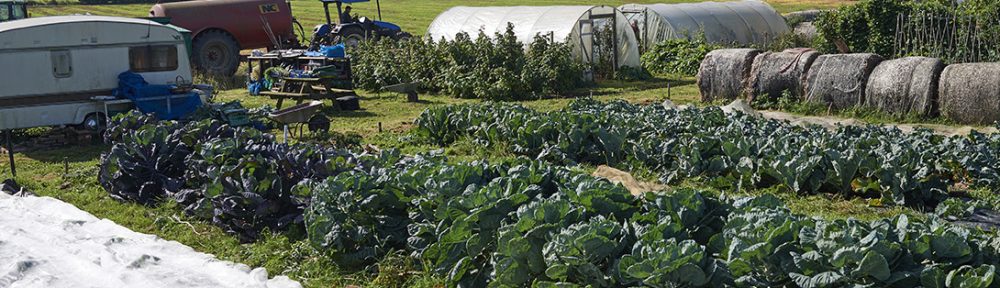
The parts of the field not being planted this year were ploughed and slurried on Thursday although no slurry was applied to the area to the right of the path so we can expand here if needed. Jonah and David will power-harrow the whole ploughed area when they judge it to be dry enough, probably in about 2 weeks.

All the greens were harvested from the tunnel to make way for 4 rows of first early potatoes.

Farm Work Day February 2nd

There was a very full turnout at the field today. We began by seeing how many DCF members fit into a small caravan – answer about 12. Frances handed out some very good cheese scones and chocolate brownies and hot drinks. We had snow, sleet, rain and sunshine but all with a bitter wind.

After some minor controversy over courgettes (zucchini to some) we settled on the range of crops for next year based on Chris Ls survey of members wishes but there is plenty of space on site for those who would like to do something extra, probably in the garden plots behind the caravan which we are taking over this year.

Under Gabbis direction we decided on the area to be cultivated this year and marked it out with canes. The planting areas will be plotted and finalised at our next meeting. Mr Mitchell will plough the rest and we will seed it with clover and rye grass to keep down the weeds and maintain the fertility.

The field is still producing and celeriac, leeks, cabbages, broccoli and sprouts were harvested.

A guesstimate of £35.00 per member contribution for the coming year was arrived at. Good value for a years veg!

The Year Ahead for DCF

Life on the field at Winfarthing in 2012 was a learning experience and a tough one for the dedicated helpers. We saw and felt for real the challenges that the weather will throw at those who grow our food for us. We also battled with the harvesting and distribution problems of a veg box scheme run by a limited number of volunteers.

For 2013 we will continue veg growing at Winfarthing on an allotment model where a share of the produce will depend upon a consistent and fair contribution to the work needed to grow and care for it. A growing group has assembled and is making plans for what to grow and how much of the field to bring into production in readiness for the new season which is almost upon us.

The Co Ordinating group is meeting to re focus our basic aim and develop other activitites such as: a food hub, group buying schemes, seed sharing, permaculture, education and social activities.

Much to do!

It was cold on the field today!

We went out to Winfarthing today to have a walk in the snow and look at the field. The leaves in the poly-tunnel closest to the door look very frosted and sad, but those in the middle have faired better. There were the paw-prints in the doorway. Some of the brassica nets have collapsed under the weight of snow – we left them for time being since the snow is probably a good insulator against very low temperatures, but a job will be needed after the thaw, along with all the other jobs!        Chris Lewis

Winfarthing in January 2013

Chris Lewis and I were at the field today, on a cold wintry morning.  I thought it was looking wonderful, clean, productive for winter, ready for us to do a lot more.

We watered the leaf vegetables in the polytunnel and harvested some carrots, parsnips, beetroot and some salads.  A very short work session, but enjoyable.

This slideshow requires JavaScript.


AGM

Hi, advanced warning for all DCF members of the AGM
Date :  Monday 22nd October
Time : 7:00pm
Location: Fighting Cocks pub, Winfarthing
 
further details nearer the time, but please can you make a note in your diary.
Thanks

Carnival 2012

The sun shone, the whistled deafened, the kids had a great time! Thanks to everyone who put so much work in decorating the tractor and thanks to everyone who turned out to support the Farm.


This slideshow requires JavaScript.

DCF from the air.

Last night, after several attempts were thwarted by the weather, Adam and I finally got to ride in a hot air balloon. As luck would have it we managed to fly over 2 DCF sites so I thought I’d share a view of the Farm that only the birds normally get.

Here’s the new land off Snow St – it may be a dull field but it’s our field!


And here’s Kadesh – our pigs are under the pilon. If you click on the photo a larger version will open and you can actually see our pigs wandering around their enclosure.