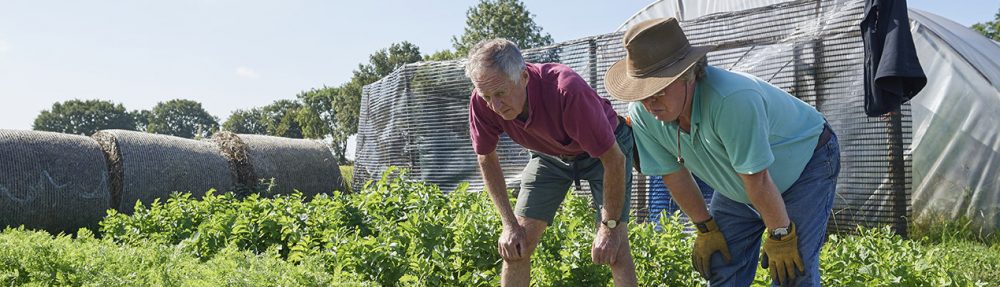
The weather favoured us this week, and we accomplished a lot. Look at that great harvest! The potatoes and the strawberries were really fabulous. I did a lot of weeding, first with an ordinary hoe and then with our new (actually very old) wheeled hoe, which is very much more efficient.
Author Archives: garyalex
The elfin barn owl
Driving home after dark last week, a beautiful barn owl flew ahead of me all the way along the Hinderclay Road, and then settled, with his back to me, on a fence post right by the road as I stopped beside him for a good look. After a few moments he looked over his shoulder at me as if to say “Oh, I wondered where you’d got to”, before flying off into the night.
My favourite bird artist, R B Talbot Kelly, wrote of a similar experience in the 1950s, when a barn owl flew 30 or 40 yards in the beam of his headlights. “I always feel there is something elfin about a barn owl,” he wrote, “its very colour is that of faerie.” He describes the barn owl’s flight as “of the same airy, floating nature as the harriers. In the half-light the bird resembles nothing so much as a large tuft of thistledown blown by some small, gusty wind.” Similarly, George Macbeth, in his poem Owl, describes him as “a feather duster in leafy corners ring-a-rosy-ing boles of mice.” Like all owls, its flight is silent, and Talbot Kelly describes how, one evening, the barn owl “passed within inches of my cheek with a silence and gentleness of a great snowflake. Seen thus, it is a most lovable bird with its eyes glowing darkly in a gnome-like face.”
In Norfolk the barn owl is known by many names including Billy wix, Madge howlet and Gilly howter, although my source, Provincial Names and Folk Lore of British Birds, published in 1885, doesn’t explain their derivation. In many countries its appearance foretells misfortune or even death, and this is reflected in the title of Margaret Craven’s novel, I Heard the Owl Call My Name, which tells of the Kwakwaka’wakw belief that an owl that calls your name is calling for your soul to rejoin the spirits in the other world. These associations no doubt derive from the bird’s nocturnal habits, its white plumage and its call, which that more down-to-earth authority, Witherby’s Handbook of British Birds, describes as “an eerie, long-drawn shriek, often in flight.” But the owl is also associated with wisdom and was sacred to Athene, the goddess of wisdom, who sees even in darkness.
Is Diss ready for the carrot mob?
Have you come across Flash mobs? These are events where a group of people assemble suddenly in public to sing, dance or provide some other form of entertainment, and then disperse as quickly as they assembled. They’re great fun, and you can find plenty of entertaining videos of flash mobs on the internet.
Flash mobs are purely for entertainment, but there is a similar event, known as a carrotmob, that has a definite purpose, which is to improve the environmental or social credentials of shops and businesses in a local area. We’re all familiar with the concept of boycotting certain stores or products when we are unhappy with their environmental or ethical performance. A good example is the very effective 1980s boycott of aerosols containing harmful CFCs. But although it may contribute to worthwhile changes, a boycott can be seen as negative, targeting things we don’t like and working against, rather than with, businesses. It relies on the stick rather than the carrot. By contrast, a carrotmob works with businesses to achieve positive change.
At its simplest, a carrotmob is a campaign where a group of people spend money to support a business that is making improvements that people care about. For example, in San Francisco, in one of the first carrotmobs, twenty-four shops bid against each other to attract the carrotmob, with the successful bidder committing 22% of the day’s takings to environmental improvements. On the day of the carrotmob, 300 shoppers spent over $9000, and the store owner spent over $2000 of this on improvements to lighting and hazardous waste disposal.
Carrotmobs are now taking place all over the world. They have been used to reduce the water footprint of a local café in Budapest, buy an energy efficient freezer for a food store in California, install energy efficient lighting in a shop in Antwerp, stop providing plastic carrier bags in a shop in Thailand, and create a vegetable patch and improve composting at a restaurant in Australia.
To organise your own carrotmob just choose an issue you care about, build a team to support the campaign, talk to local businesses to see who will take action, and then pick a time and date for the event. Possible issues include environmental improvements, increasing fair trade, increasing trade in organic, local or healthy food, boosting the local economy, and many more.
Is Diss ready for a carrotmob?
Hedgehogs in decline
That prickly but endearing mammal, the hedgehog, is in serious decline. UK numbers fell from a population of around 30 million in the 1950s to only 1½ million in 1995, a decrease of 95%. Hedgehog numbers have continued to plummet, falling by over a third between 2003 and 2012. There may now be fewer than a million left.
There are a number of factors that might explain this dramatic decline. Habitat loss and habitat fragmentation are of particular concern. The larger fields, fewer hedgerows and loss of permanent grassland that accompany intensive agriculture reduce the suitable habitat. Pesticides reduce the numbers of prey available to hedgehogs, and weather also affects the availability of prey, especially unusually wet or dry summers. This is likely to be exacerbated by climate change, which is expected to increase the occurrence of extreme weather.
New buildings and new roads eliminate suitable habitats, while increasing traffic increases the number of road casualties – tens of thousands of hedgehogs are killed on our roads each year.
The decline has been greater in rural areas than in urban ones because gardens have, in the past, provided valuable habitats for hedgehogs. However, even in gardens, suitable habitats are declining where gardens are smaller and tidier, or where lawns and flower beds are converted to patios, decking or hard standing for cars. In addition, fences and walls prevent hedgehogs moving from one garden to the next. Hedgehogs and other wildlife rely on connections between suitable habitats – referred to as wildlife corridors – to move around their territory and find food and shelter.
Gardens can also contain hedgehog hazards such as steep-sided ponds, strimmers, slug pellets, netting that can entangle the animals, or bonfires that they may crawl into for shelter.
In hedgehog-friendly gardens, lawns, flower beds and compost heaps all provide nutritious prey such as earthworms, beetles, snails, slugs and caterpillars. Gardens can also provide water and shelter and, if sufficiently undisturbed and secluded, can provide suitable areas for breeding and hibernation. In return, the gardener benefits from the large number of slugs and other garden pests that the hedgehog devours.
You can help your neighbourhood hedgehogs by making sure your garden provides a rich habitat that is free of hedgehog hazards. Also ensure that the animals can gain access by replacing fences and walls with hedges, or making small holes at the base so that hedgehogs can move freely from one garden to the next. A gap of only 15 cm is sufficient.
No-dig cultivation
Labour is one of the most important resources for the farm since we rely heavily on volunteers to cultivate and harvest the crops. So anything that reduces labour is of great interest to us. One approach we are interested in is permaculture, and one aspect of this is called no-dig cultivation. The idea of not digging the plot is certainly attractive! But digging is said to break up the soil, improve its structure and help to control weeds. So what will happen if we don’t dig?
The most important aspect of no-dig gardening is mulching. At the end of the season the soil is covered with a deep mulch of organic material. This might be compost, rotted horse manure, leafmould, old straw or spent mushroom compost. The mulch keeps the soil warm, which encourages the natural population of earthworms to remain active. The worms work hard taking the mulch down from the surface into the soil below and, in the process, their tunnels help to aerate and drain the soil, gradually improving its structure. The mulch also helps to retain moisture, and the slower percolation of water through the soil means that fewer nutrients are leached. In addition, the mulch increases the fertility of the soil and suppresses weeds, while the undisturbed soil environment encourages a more balanced soil population with beneficial rather than harmful fungi, resulting in fewer pests and diseases compared to a well-dug soil. Some of the vegetables we plant also help to develop the structure of the soil. Leeks, parsnips and potatoes are particularly good at this.
No-dig vegetable beds are not new to community farming. The Kippax CSA (community supported agriculture) in West Yorkshire practises permaculture, including the no-dig system. The project is organic and doesn’t use agricultural machinery, so they use no-dig beds to save both labour and fossil fuels. They initially found the process of creating the no-dig beds time consuming, but in the longer term reduced the time needed for digging, weeding, watering and, because the crops come out of the soil more easily, harvesting.
Further progress!
The Diss Community Farm is really shaping up now, as you can see from the photos below. We’re farming only part of the field, but look at the green manure coming up on the rest. We’ve got a nice new hand hoeing tool, that makes keeping up with the weeds much easier. Potatoes, brassicas, beans all in progress.
And look at that harvest: loads of spinach, leeks, spring onions, beetroot. Not bad for the hungry gap?
Protecting our bees
Last week EU states voted on a proposal to restrict the use of neonicotinoides, pesticides that threaten the survival of bee colonies. The proposal had considerable support but, sadly, not from the UK government.
This is not the first time the European Commission has sought to ban the chemicals. After studying all available evidence, the European Food Safety Authority (EFSA) concluded that neonicotinoids present an unacceptable danger to bees. In January, in response to the EFSA’s report, the European Commission proposed a two-year suspension of these pesticides, and the proposals would have entered EU law in February if a majority of member states had voted in favour. However, the proposal failed after several countries opposed the suspension while Britain and Germany abstained.
The failure pleased chemical companies Bayer and Syngenta who claimed that the EC “relied too heavily on the precautionary principle”. Defra, similarly, suggested that the EU was rushing the proposal through. The UK environment secretary, Owen Paterson, supported by the government’s chief scientific advisor and by the NFU, asked the EC to postpone the decision and wait for further research.
But, John Gummer (now Lord Deben), former environment minister, criticised Paterson’s stance, saying that bees are too important to take such risks. Almost three-quarters of the UK public support the ban, and last week a petition with 300,000 signatures was delivered to Downing Street, while 2½ million people signed a petition online. Even retailers supported the ban by voluntarily ceasing to stock the chemicals.
More than 30 scientific studies carried out in the last three years have shown that neonicotinoids have a harmful effect on bees. These insect neurotoxins attack bees’ nervous systems and affect memory, learning and navigation. The pesticides have been linked to a 50% fall in both UK and US honey bee numbers over the last 25 years, a doubling of the number of bees that fail to find their way home after foraging for food, and increased sensitivity of hives to parasites and lack of food. Researchers also found an 85% drop in the production of queen bees. Queens are the only members of the colony that survive the winter and are therefore essential for establishing new colonies the following year.
Last week the EC took the proposal to an appeals committee and gained the right to enforce a ban despite members’ failure to agree. It will impose a two-year restriction on the chemicals, beginning no later than 1 December.
The Farm is looking good!
In its current incarnation as a shared allotment, the Diss Community Farm field in Winfarthing is in very good shape at present.
A small, but growing group of us have been working their through the winter, and we’ve even got some harvests! (Some leeks and spinach today.) We are up to about 15 members now, all of whom work regularly on the field, and are open to taking a few more, up to about 20.
We’ve reduced the land we’re working on, and planted a green manure on the rest. We’ve been building compost bins, fixing up the fences, clearing up from last year’s crops. It’s all looking very tidy, and planting for this season is well under way. Our main work days are Thursday mornings, and also the third Saturday of the month.
Here are some pictures taken today and last week.
Ecological footprints
An ecological footprint can be defined as the amount of land required to support the current lifestyle of an individual or community. This isn’t just the land that grows our food but also includes the land needed to produce all the other goods, energy and water that we consume, and to absorb the waste that we produce. It is said that if everyone lived the lifestyle of the average American, we would need five planets to support us.
Trying to reduce our ecological footprint can be very complicated if we try to work out the full impact of everything we buy. Consider something as simple as a strawberry yoghurt. In addition to the production methods of each ingredient and the yoghurt itself, we also have to consider the production and disposal of the packaging and the transport of the yoghurt and its ingredients. American researchers have calculated that the total miles travelled by a strawberry yoghurt and all of its ingredients could be as much as 2216 miles.
However, there is a simpler way to approach the problem. If you think of your house, garden and car as a system that represents your lifestyle, then everything that enters or leaves this system has an environmental impact. So a way to reduce your ecological footprint would be to reduce the things entering or leaving your personal system, and also to simplify them so that it is easier to understand their impact. To give just one example, proprietary brands of cleaning products contain a mix of unfamiliar ingredients, so working out the environmental impact of, say, a bathroom cleaner can be very complex. But most household cleaning can be accomplished with a very small number of basic ingredients including vinegar, salt, lemon juice and bicarbonate of soda. So instead of trying to understand the impact of your current cleaners, just switch to simpler materials. This principle can be applied in many ways including buying fresh local cooking ingredients instead of prepared meals.
Diss Community Farm has a responsibility for both sustainability and education, and the sharing of knowledge and experience within our community of members helps us to reduce our ecological footprint. We are currently exploring this through cooperative buying, initially operating informally by identifying local suppliers who share DCF’s values, together with companies from further afield who supply ethical products that can’t be obtained locally. By placing orders and arranging collection cooperatively we can increase our support of these suppliers and reduce our ecological footprint in the process.
Sowings so far
A brief report on Thursday’s activities in the greenhouse at Gabbi’s on the 18th.
We sowed in pots & plugs:Long courgette, a few round courgette, cucumber, butternut squash, ichi kuri squash (misspelt I know), crown prince squash, pumpkins, cobra beans, blau hilde beans, borlotti beans, fennel, drumhead cabbage, pointy cabbage(unofficial name!), calabrese, purple broccoli and sunflowers.
Gabbi has already started quite a few other things, including, leeks, radishes and salad leaves.
Penelope